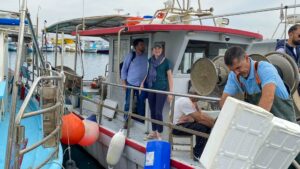
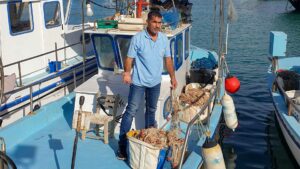
Small-scale fishers form the backbone of coastal communities across the Mediterranean, yet they consistently struggle to access the European funding meant to support them. A WWF Portugal / BlueMove project in Portugal’s Algarve region set out to change that. Over fourteen months, it tested whether hands-on technical support could turn eligible fishers into successful applicants, producing once more results and lessons that go well beyond Portugal’s coastline.
Why small-scale fishers struggle to access EU fisheries funding
Small-scale fishing crews make up the vast majority of Europe’s fishing fleet, but they rarely see a matching share of public support. Independent analysis of EU fisheries funding has found that small-scale coastal vessels, despite representing roughly three-quarters of the EU fleet, receive a disproportionately small slice of the money channelled through the European Maritime, Fisheries and Aquaculture Fund (EMFAF).
EMFAF designates small-scale coastal fishing as a funding priority, offering aid rates of up to 100% for many onboard investments. In Portugal, this fund is delivered nationally through the MAR2030 programme, which the European Commission describes as aiming to make financing easier to reach while improving outcomes for coastal fleets.
In practice, the application process tells a different story. Grant forms are long, documentation requirements are extensive, and fishers are usually expected to pay for equipment upfront and wait months for reimbursement. This structural barrier keeps many eligible applicants out entirely, as French newspaper Le Monde documented in 2023. Small-scale fishers are a significant part of the Mediterranean’s social and economic fabric, accounting for close to 60% of all onboard fishing employment in the region, according to WWF’s Mediterranean Marine Initiative, which makes the funding gap all the more consequential.
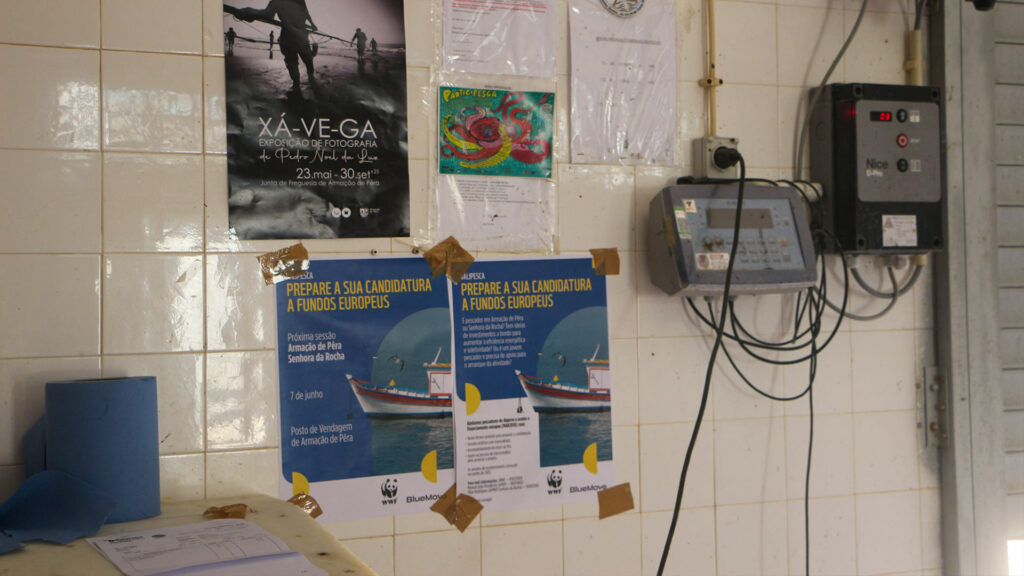
ValiPESCA was designed as a direct response to this gap. Implemented by WWF Portugal between January 2025 and March 2026, in partnership with the BlueMove fund, the project provided free technical assistance to help small-scale fishers in four Algarve communities (Monte Gordo, Armação de Pêra, Senhora da Rocha and Alvor) prepare complete, fundable MAR2030 applications.
How ValiPESCA guided Algarve fishers through the MAR2030 process
The project began with groundwork rather than outreach. Before any fisher was contacted, the team reviewed every MAR2030 call relevant to small-scale fishing and mapped its eligibility rules, deadlines and beneficiaries. This was followed by an in-depth assessment of several candidate fishing communities, carried out through meetings with researchers, national fisheries authorities and local focal points, to understand where support was most needed and most likely to succeed.
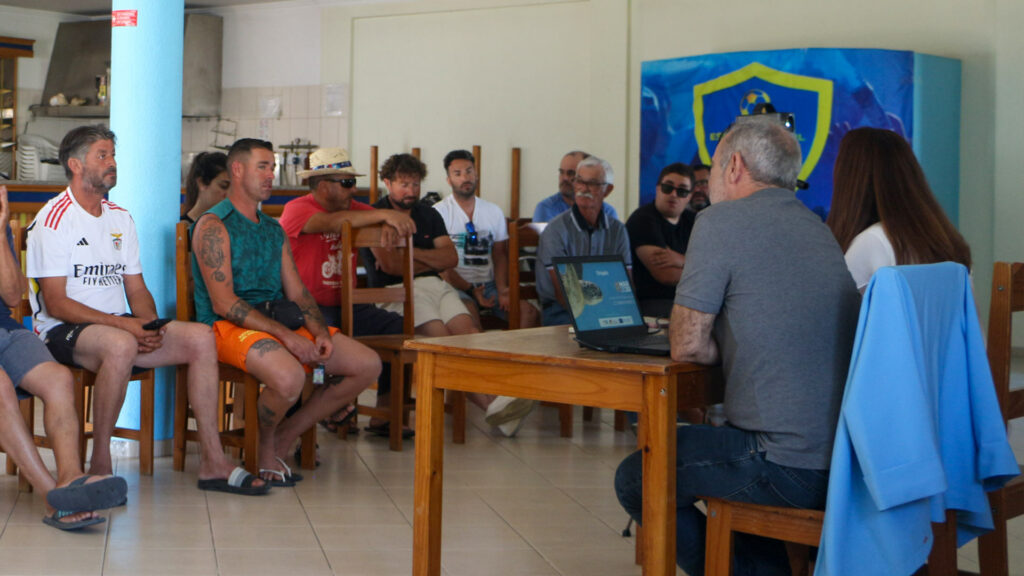
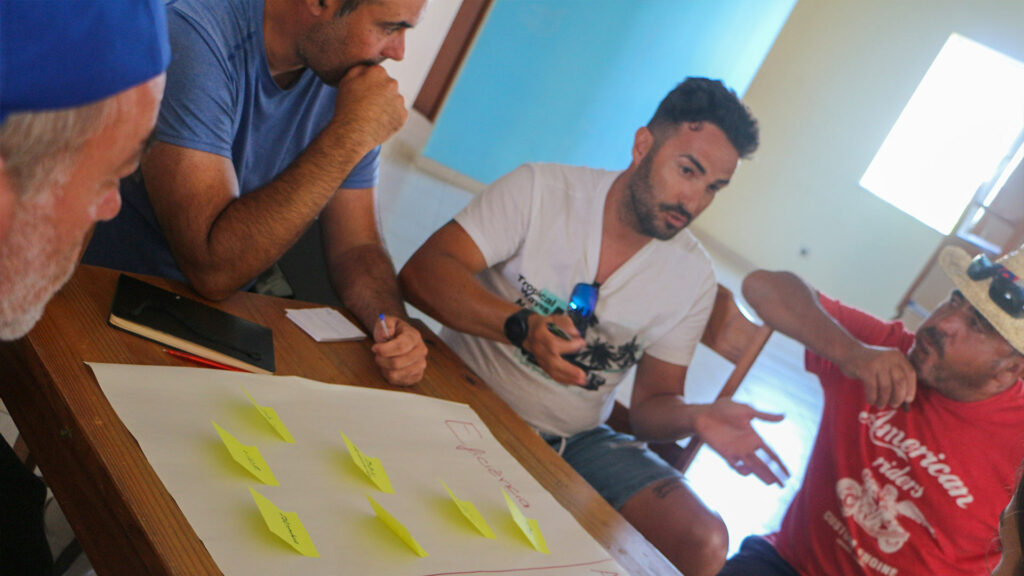
Four training workshops, held in two rounds during June and July 2025, then brought the process to fishers directly. The first round introduced the available MAR2030 calls with officers from the managing authority present to answer eligibility questions on the spot. The second round returned with tailored feedback on each fisher’s investment ideas and walked participants through the next steps, supported by a plain-language flyer explaining requirements and listing the documents needed. In total,
- 27 fishers took part in these sessions.
A concrete case illustrates how the support worked in practice. One fisher in Senhora da Rocha wanted to improve onboard storage and energy use, applying for a solar panel and an insulated container to preserve octopus catches at sea. Without support, working through MAR2030’s eligibility criteria, budget templates and supporting documents would likely have been a significant obstacle. With a technical adviser guiding the process step by step, the application was completed and submitted as part of the programme.
From this workshop base,
- 17 fishers expressed concrete interest in receiving individual technical assistance, and
- 14 confirmed and began gathering documents.
The investments fishers applied for fell into five broad categories: energy efficiency (propellers, engines), safety equipment (bilge pumps, life vests, VHF radios), working conditions (protective wheelhouses, deck lighting, work suits), catch quality (insulated containers) and gear selectivity (to reduce bycatch or improve waste management).
Not every investment had a direct environmental purpose, but even purely practical upgrades, such as a safer wheelhouse or better lighting on deck, translate into real improvements to fishers’ day-to-day working and living conditions, which matters just as much to a programme built on trust and long-term engagement.
The team supported each of them directly: clarifying requirements, preparing forms, and troubleshooting the multiple online platforms that a single MAR2030 application can require.
What the project achieved, and what it revealed about scaling up
The numbers
- Of the 14 fishers who began the application process,
- 11 completed and submitted their MAR2030 applications;
- 3 dropped out along the way, mainly after struggling to gather the required paperwork.
By the time the project closed, MAR2030 had already issued three requests for clarification on submitted files, a sign that formal evaluation was actively under way. Communication efforts around the launch reached well beyond the four target communities too: a press release announcing the project was picked up by 18 regional media outlets.
The project’s impact also extended beyond the fishers it directly supported: by raising awareness among Portuguese institutions of the barriers small-scale fishers face when applying for public funding, it is expected to lead to around ten dedicated support desks opening to assist future grant applications.
The limits, and what they teach
The project’s finding is that funding-access support alone does not guarantee high take-up. Many fishers, once they understood the scale of the administrative burden, chose to self-finance small upgrades rather than apply, even with free technical help on offer. Those who did pursue MAR2030 support were mostly fishers planning larger investments, for whom the funding was essential rather than optional.
This created a genuine mismatch: fishers with real interest but no spare cash could not move forward without pre-financing, while fishers who could self-fund smaller purchases had little incentive to engage with a lengthy process at all.
The team also worked to close that pre-financing gap directly, holding discussions with MAR2030, a fishers’ mutual insurer, and two Portuguese banks between April 2025 and February 2026. None of the fishers who requested support ultimately chose to use pre-financing because the interest rates offered by the financing institutions approached were considered too high to be worthwhile.
This mirrors what a comparable BlueMove deployment found in Cyprus around the same period, where banking requirements for collateral and branch-level approval proved incompatible with the scale and timing of small-scale fishing projects, and where reimbursable grants had to fill the gap instead. Seeing the same structural obstacle emerge independently in two countries is a strong signal for anyone weighing where to invest next: pre-financing, not technical assistance alone, is the piece still missing from this model.
A proven model, ready to scale
ValiPESCA shows what focused technical support can achieve for small-scale fishers navigating EU funding, and it shows, just as clearly, where the model still needs strengthening. Eleven completed applications from a community with no prior track record of engaging with MAR2030 is a meaningful result. The recurring finding that pre-financing, not paperwork alone, decides whether interested fishers actually apply is arguably just as valuable: it is a specific, addressable problem that a small, targeted investment could help solve at scale.
For donors, this is a project with a clear next step rather than an open-ended experiment. For NGOs working with small-scale fishing communities elsewhere in the Mediterranean, it is a tested framework, combining workshops, individual technical assistance, and a documented approach to pre-financing, ready to be adapted to local contexts.
Frequently asked questions
What is EMFAF, and how does it relate to MAR2030 in Portugal?
EMFAF is the EU’s fund for maritime and fisheries policy for 2021 to 2027, with a budget of over €6 billion. MAR2030 is how this funding is delivered to applicants in Portugal, including small-scale fishers.
Why did fewer Algarve fishers apply to MAR2030 than expected?
Many fishers in the targeted communities were interested in improving their boats and gear, but once they understood the extent of the paperwork and waiting time involved in a MAR2030 application, several preferred to fund small upgrades themselves rather than engage with a lengthy administrative process. This reduced the pool of applicants and required extra effort from the project team to keep interested fishers engaged throughout the process.
What did the ValiPESCA project achieve in Portugal?
Working with 27 fishers across four Algarve communities, the project supported 11 completed MAR2030 applications and generated wide regional media coverage, while identifying pre-financing as the main remaining barrier to scale.
Could the ValiPESCA model be replicated in other Portuguese regions or countries?
The project was a pilot deliberately tested in a handful of Algarve communities to validate the approach before scaling it further within Portugal. The same BlueMove model, combining technical assistance with EU fisheries funds, has been deployed in Croatia, Cyprus and Greece, with comparable barriers and lessons emerging across sites, reinforcing the case for expanding it to further Portuguese fishing communities or other Mediterranean countries.
How can donors or NGOs get involved with Portuguese fishers?
Some fishers who showed real interest in applying could not move forward, because they lacked the funds to cover investment costs upfront while awaiting MAR2030 reimbursement, despite WWF Portugal’s efforts to broker a pre-financing solution with several banks and a fishers’ mutual insurer. This remains the project’s central open question, and it is exactly where new funding could have outsized impact: donors can support the development of a dedicated pre-financing facility, alongside continued technical assistance, so fishers with strong project ideas are no longer excluded by cash-flow constraints alone. NGOs working with Mediterranean fishing communities can explore partnering directly on future deployments of this model.