Small-scale fishers keep Mediterranean coastal communities alive, yet they rarely see the EU funding meant for them. Grant schemes reimburse costs only after purchase, and few banks are willing to lend to a sector with unpredictable income. BlueMove was created to close that gap.
In Cyprus, working alongside Enalia Physis Environmental Research Centre, the programme tested a model that combines technical assistance with pre-financing. The project shows what it takes to make EU fisheries funding reach the people it is designed for, and what still gets in the way.
Small-scale fishers in Cyprus struggle to access EU funding
Small-scale fisheries designate low-impact, coastal fishing activities carried out by individual operators or small crews, usually with limited capital and little administrative support. Across the Mediterranean, this sector is widely recognised as culturally and socially vital to coastal communities, even where its direct contribution to national output is modest.
Cyprus illustrates this tension well. Small-scale fishing contributes a limited share of the country’s economic output, yet it remains central to coastal livelihoods and identity, as shown by a participatory study of the Cypriot fisheries sector combining fishers’ and scientists’ perspectives. Fishers face a combination of pressures: declining marine resources, high fuel costs, competition with recreational fishing, and an ageing workforce with little generational renewal.
The European Maritime, Fisheries and Aquaculture Fund, known as EMFAF, is the main public funding route available to address these pressures. Cyprus has been allocated 38.3 million euros in EMFAF funding for the 2021 to 2027 period, implemented nationally by the Department of Fisheries and Marine Research, under grant schemes covering monitoring equipment, vessel investment, deterrent devices for protected species, and compensation for damage caused by protected mammals.
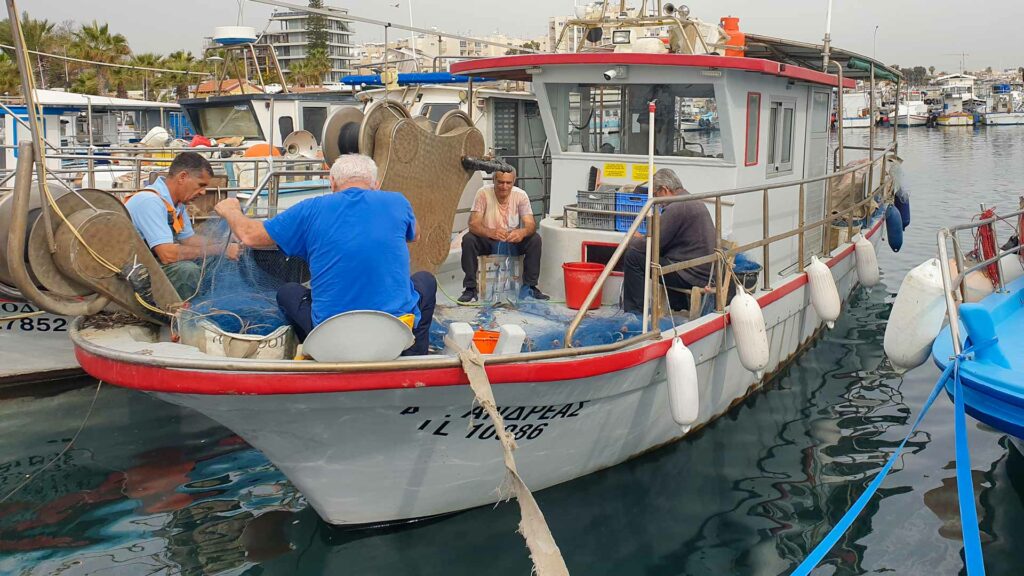
The problem is not a lack of funding intent. It is delivery. EMFAF grants reimburse costs only after equipment is purchased and installed, and the application process itself demands administrative skills many small-scale fishers do not have time to build. BlueMove was designed around these two barriers specifically: the paperwork burden of grant applications, and the need to pay suppliers before any reimbursement arrives.
We combined workshops, technical assistance and pre-financing
BlueMove’s Cyprus workstream started with groundwork rather than delivery. During 2024, Enalia Physis produced a sector diagnosis and mapped the EMFAF grant schemes most relevant to small-scale fishers. That inception phase shaped everything that followed.
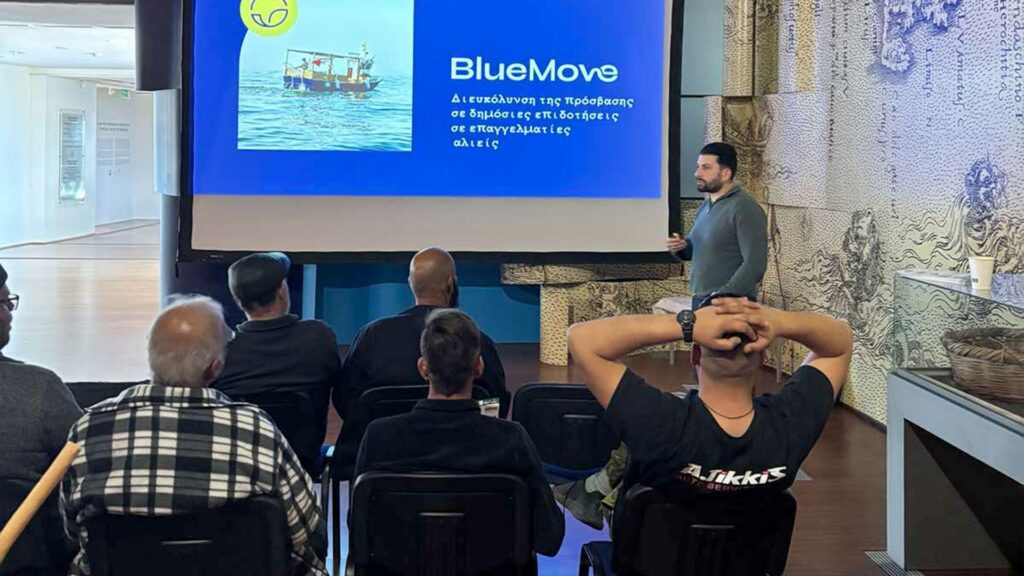
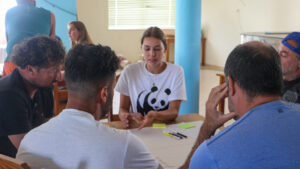
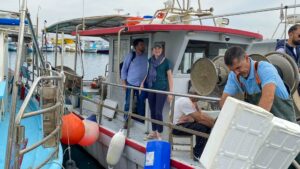
In 2025, the programme moved into active delivery. Six workshops were held across coastal towns including Ayia Napa, Larnaca, Zygi, Limassol, Paphos and Latsi, reaching 66 participants. Twenty-five fishers expressed strong interest in applying for support, most of them engaging with EMFAF for the first time.
A knowledge exchange visit with WWF Greece, organised in March 2025, added a wider regional perspective. It surfaced governance concerns, such as unmonitored recreational fishing volumes, and confirmed a recurring operational problem: dolphin depredation was damaging nets and gear across the region, making deterrent devices a priority investment.
Fisher demand did not always match what the active EMFAF call actually covered. Many fishers wanted support for traps, a selective and passive technique, but traps were not eligible under the funding window in place at the time. This eligibility gap meant technical assistance ultimately narrowed from 25 interested fishers to 8 who entered the formal application process, all for dolphin deterrent devices.
Pre-financing proved even harder to solve. Commercial banks required specific documentation that BlueMove could not provide, and discussions with the Bank of Cyprus confirmed that expected EU grants were not factored into repayment assessments. When bank-based solutions could not be arranged in time, BlueMove adapted by providing reimbursable grants directly to fishers, allowing them to pay suppliers without waiting on a bank.
For example, Elias, a small-scale fisher using static nets, received support to acquire dolphin deterrent devices through BlueMove. He has also adapted his vessel for tourism activities, combining fishing with a diversified income stream. He has said the high cost of effective deterrent equipment would have kept it out of reach without EMFAF backing and BlueMove’s hands-on application support.
Results and lessons from this project in Cyprus
The 2025 project produced a clear, if modest, set of outcomes.
- 24 fishers entered the application process,
- 8 obtained support to acquire dolphin deterrent devices, and
- 6 applications were formally approved.
- 6,396 euros were reached in total in EMFAF funding requested through the programme
- 58% of applicants were engaging with EMFAF for the first time,
- 79% had never worked with Enalia Physis before, showing that the programme reached genuinely new participants rather than an existing network.
- 4 fishers who could not secure bank pre-financing received reimbursable grants directly from BlueMove, totalling 16,985 euros. This flexibility kept their projects moving when banking pathways failed.
The project also exposed real limitations. Delivery delays from the equipment supplier meant devices arrived after the funding deadline, and the four related applications were ultimately cancelled, a loss BlueMove absorbed on the advance payments already made. Separately, other EMFAF-adjacent calls launched during the same period showed similar structural issues elsewhere in the system: a vessel investment call exhausted its entire budget on its first day under a first-come, first-served rule, while a call for monitoring equipment saw almost no uptake because fishers did not see it as a practical priority.
Together, these experiences point to four consistent lessons for anyone designing similar support:
- Eligibility rules matter as much as budgets. Well-funded schemes still fail fishers if the equipment they actually need falls outside the active call.
- Pre-financing is the real bottleneck. Reimbursement-based grants structurally disadvantage operators without access to capital, regardless of how strong their application is.
- Technical assistance is not optional. Trusted, one-to-one support is what turns funding eligibility into a completed application.
- Adaptive delivery protects trust. When formal pathways stall, flexible alternatives keep beneficiaries engaged instead of walking away.
Together, these experiences point to four consistent lessons for anyone designing similar support:
Adaptive delivery protects trust. When formal pathways stall, flexible alternatives keep beneficiaries engaged instead of walking away.
Eligibility rules matter as much as budgets. Well-funded schemes still fail fishers if the equipment they actually need falls outside the active call.
Pre-financing is the real bottleneck. Reimbursement-based grants structurally disadvantage operators without access to capital, regardless of how strong their application is.
Technical assistance is not optional. Trusted, one-to-one support is what turns funding eligibility into a completed application.
These are not abstract findings. They come directly from a project that mobilised fishers, tested banking partners, and adjusted its model mid-course rather than declaring an early win.
Backing what already works
The Cyprus experience shows that demand for sustainable investment among small-scale fishers is real, and that it can be mobilised quickly once the right support is in place. It also shows, honestly, where the model still needs strengthening: eligibility alignment, faster pre-financing pathways, and closer coordination with banks and managing authorities.
As EU fisheries funding moves toward a new budget structure beyond EMFAF, the window to test and refine fisher-centred financing models like this one is now, not later. Funders looking to back a proven, adaptable delivery model, including reaching the fishers left without support in this first project, and NGOs working with Mediterranean fishers who want a ready framework to build on, both have a reason to look closely at what BlueMove has already delivered in Cyprus.
Frequently asked questions
What is BlueMove and how did it work in Cyprus?
BlueMove is a pre-financing and technical assistance mechanism that helps small-scale fishers access EU funding for sustainable equipment. In Cyprus, it operated in partnership with Enalia Physis Environmental Research Centre, combining outreach workshops, one-to-one application support, and pre-financing solutions so fishers did not need to cover costs upfront.
Why is pre-financing such a barrier for small-scale fishers in Cyprus?
Most EU grant schemes reimburse costs only after purchase and installation. In Cyprus, discussions with the Bank of Cyprus confirmed that commercial banks require collateral few small-scale fishers hold, and do not factor an expected EMFAF grant into repayment assessments. This leaves a financing gap that formal lenders are reluctant to fill.
What were the results of BlueMove’s first delivery in Cyprus?
Eight fishers received technical assistance to apply for EMFAF funding, six applications were approved for dolphin deterrent devices, and four fishers received reimbursable grants worth 16,985 euros when bank pre-financing could not be arranged in time.
Could the BlueMove model be replicated in other Mediterranean countries?
The Cyprus project suggests the core components, workshops, hands-on technical assistance and a pre-financing backstop, are transferable, provided they are adapted to each country’s grant eligibility rules and banking landscape.
How can donors help small-scale fishers in Cyprus?
Seventeen of the fishers who first expressed interest could not be supported in this project, mainly because their preferred equipment, such as traps, fell outside the active EMFAF eligibility window. Their interest in transitioning to more sustainable gear did not disappear, it simply had nowhere to go within the current eligibility window. Donors can help close this gap by funding these fishers, while also partnering with BlueMove to replicate the model, workshops, technical assistance and pre-financing combined, in other Mediterranean countries with interested NGOs.